



Key Takeaways
- Warehouses utilize material handling systems such as conveyors
- Warehouse conveyors are specialized systems that aid in product flow
- There are multiple types of warehouse conveyors
- Warehouse conveyor selection and design are dependent on the layout
- How does automation affect warehouse conveyors?
- Common mistakes to avoid during warehouse conveyor selection
What Are Warehouse Conveyor Systems?
Definition Of Warehouse Conveyor Systems
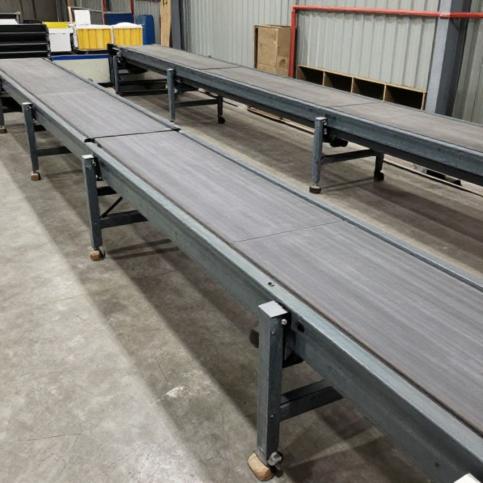
A warehouse conveyor system is defined as a specialized type of conveyor system that facilitates the movement of goods from one point to another in the facility without interruptions.
How Conveyor Systems Move Goods Through A Warehouse
Conveyor systems move goods through a warehouse via belts, chains, rollers, or similar combinations so that they move along a straight line from point A to point B. The goal is to make the process as automated as possible to improve efficiency and reduce errors.
Where Conveyors Fit Into Receiving, Picking, Packing, And Shipping
Warehouse conveyor systems are the backbone of major warehousing operations such as receiving, picking, packing. and shipping. In each case, they remove manual intervention, improve process operations, and ensure accuracy in packing and shipping.
Why Conveyor Selection Depends On the Entire Workflow
Proper selection of warehouse conveyors depends entirely on the workflow of the facility, as it is not an isolated transport tool. Instead, it must match the order journey of each package in a warehouse, ranging from receiving to picking, packing, dispatching, and so on.
What Types Of Warehouse Conveyor Systems Are Available?
| Conveyor Type | Best Suited For |
Power Requirement |
Typical Warehouse Use |
Belt Conveyor Systems
|
Belt conveyor systems are best suited for moving goods along flat or inclined paths |
They are powered by motors, and friction ensures adherence between the belt and the product |
Best used in packaging lines and sorting operations in warehouses
|
Live Roller Conveyor Systems |
Live roller conveyor systems use a combination of rollers with a belt on top or a line of exposed cylindrical rollers |
While roller conveyors can be non-powered, live roller conveyor systems are run by motors |
In warehouses, they are typically suited for transporting heavy and stable items such as boxes and pallets in shipping and receiving areas |
Gravity Conveyor Systems |
Gravity conveyor systems are simple, non-powered conveyors that move objects smoothly on a decline |
Since the main source of power is gravity, it does not have any power requirement, making it cost-effective and easy to set up |
Gravity conveyors are mainly used in loading docks, order picking, assembly, packaging, and cold storage in warehouses |
Incline and Decline Conveyors |
Incline and decline conveyors are material handling systems set at a particular gradient |
Incline conveyors have to be powered to move goods up at a certain angle. Decline conveyors can work on gravity, provided the goods being transported are not fragile |
These types of conveyors can be used in multiple places in the warehouse, such as multi-floor levels, loading and unloading docks, or parcel and e-commerce stations |
Chain And Pallet Conveyor Systems |
A chain and pallet conveyor is a heavy–duty conveyor system wherein multiple strands of chain support a heavy pallet and transport it across a facility | An electric motor powers this conveyor, guiding the chains along a track, providing constant traction without any slipping |
In warehouses, chain and pallet conveyor systems are used in loading and unloading areas, packaging, stacking, transfer hubs, and cold storage facilities |
Accumulation And Sortation Conveyors |
These conveyors accumulate products when required and sort them for different transportation lines |
They are also motor-powered and include specialized sensors and scanners to carry out accumulation and sortation |
Sorting, packaging lines, fragile handling, and pallet infeed and outfeed areas |
How Warehouse Layout Influences Conveyor System Design
Map Material Flow From Receiving to Shipping
The material flow is the most important consideration when considering warehouse conveyors. This includes mapping how the material moves from the initial receiving to the final shipping stage.
Account For Aisles, Columns, Doors, And Work Areas
The warehouse layout must also consider essential areas that cannot be covered by the conveyor. This includes aisles, any columns, doors, and work areas where manual operations take place.
Plan Transfers, Merges, Curves, And Elevation Changes
Spatial constraints must also be considered for warehouse conveyor system design as it passes through different areas of the facility between transfers, merges, curves, or moving up or down an incline. These layout considerations will make it easier to select and design an appropriate warehouse conveyor type.
Allow Space For Maintenance And Operator Access
While designing and installing the conveyor, maintenance must also be considered. There should be ample space along the conveyor for maintenance operators to access the equipment and provide routine checks and fixes.
Design Around Current And Future Warehouse Capacity
If the warehouse operations expand in the future, the conveyor system design layout should also take this into consideration, as major overhauls will not be possible.
Warehouse Conveyor Design Checklist
- Map Material Flow
- Account For Aisles, Columns, And Work Areas
- Account For Space For Maintenance And Repair
- Include Product Transfers, Merges, Curves And Gradients
- Consider Future Scalability
What Role Does Automation Play In Warehouse Conveyor Systems?
Sensors And Automated Product Detection
Sensors are invaluable in sortation and accumulation conveyors, as it helps easy detection of products for the purposes of segregation or transfer.
Conveyor Controls And Routing
The material handling conveyor systems use controls in combination with sensors, allowing for easy and accurate product routing in a warehouse with multiple product inflows.
Accumulation And Controlled Product Flow
In cases where the products have to be accumulated in clusters for controlling product flow, automation becomes key.
Sortation And Destination Routing
Sorting the conveyors based on their shipping or distribution destination can be increasingly simplified with the use of automation.
Integration With Warehouse Automation
Automated warehouse conveyor systems can be integrated with other aspects of warehouse automation for a streamlined workflow.
When Automation Adds Value To A Conveyor System
In cases where manual handling is not adept at handling the volume and complexity of product flow, automated warehouse conveyors become invaluable.
Warehouse Conveyor Selection: Step-by-Step
1. Define The Warehouse Processes The Conveyor Must Support
What are the different warehouse processes that the conveyor will support? Does it include shipping, loading, unloading, assembly, storage, or something even more specialized? Knowing conveyor system applications is a key step to determining conveyor selection for warehouses.
2. Identify The Products, Dimensions, Weights, And Load Characteristics
What type of products will be transported in the warehouse? This is key to identifying various product-related parameters such as their dimensions, their weight, and their profile. This will help select the type of conveyor, as some are better at handling heavier or irregularly shaped products than others.
3. Calculate Current And Peak Throughput Requirements
The current throughput requirements of the conveyor system must also be considered. Additionally, if the peak throughput requirements are significantly higher, they also have to be considered when choosing the right warehouse conveyor.
4. Map The Required Conveyor Route And Facility Constraints
Based on the layout of the warehouse, the conveyor route will also be defined. Aside from the layout of the warehouse, it is also important to take facility constraints into account, including spaces for other activities, columns, doors, and other regions.
5. Compare Suitable Conveyor Technologies
If a particular warehouse operation has multiple conveyors that seem compatible, make sure to compare the different technologies to see which one is right for the specific application. For instance, belt conveyor applications are vastly different from roller conveyor applications.
6. Determine Accumulation, Transfer, Elevation, Or Sortation Requirements
Is there a need for specific operations such as accumulation, transfer, elevation or sortation? If so, there will be a need for adding specialized conveyor systems such as sortation and accumulation conveyors, incline/decline conveyors, or conveyors with special equipment.
7. Evaluate Automation And Control Requirements
Some operations require a high degree of automation, whereas others can be handled with minimal manual intervention. For instance, sortation requires a high degree of automation, whereas loading docks can benefit from simple gravity conveyors.
8. Review Safety, Maintenance, And Accessibility Requirements
Safety, maintenance, and accessibility requirements are non-negotiable when it comes to warehouse conveyor considerations. This is critical as it will protect any workers who come into close proximity with the conveyor during warehouse operations.
9. Consider Future Volume And System Scalability
For any conveyor selection, future scalability is an important criterion, and this goes for warehouse conveyors as well. This will take into account the current peak throughput and future peak throughput with expanded capabilities.
10. Test Or Validate The Proposed Configuration Before Implementation
After selecting and designing a warehouse conveyor with the above-mentioned factors and considerations, it is important to put the theory to the test. Run different tests and diagnostics to see if the conveyor will be capable of performing the required tasks. This is vital before implementing it on a large scale, as major errors after installation can be hard to correct.
What to Confirm Before Finalizing the Conveyor Configuration
- Warehouse processes
- Material characteristics
- Current and peak throughput
- Conveyor route
- Conveyor compatibility
- Consider accumulation, transfer, and sorting
- Evaluate automation
- Consider safety and maintenance
- Future scalability
- Testing before implementation
Common Warehouse Conveyor Selection Mistakes to Avoid
Choosing Equipment Before Understanding Material Flow
The material flow in a warehouse is of paramount importance. Choosing a warehouse conveyor without considering this will result in long-term issues.
Selecting A Conveyor Based Only On Product Weight
While product weight is an important consideration, it is not the only one. Its dimensions also play a key role. Ignoring all product characteristics can lead to poor outcomes.
Ignoring Peak Throughput Requirements
A conveyor designed for regular throughput requirements will fail when peak conditions appear. So always design for peak throughput, and you will have a well-functioning conveyor system.
Underestimating Transfer And Accumulation Requirements
Transfer and accumulation needs can be far more than initially anticipated. Ignoring them can lead to negative outcomes.
Designing Without Maintenance Access
With warehouse conveyors, every inch of space matters. Not taking extra space for maintenance access can make upkeep difficult.
Failing To Plan For Future Expansion
Future expansion and scalability must always be considered. Failing to do so will result in expansion challenges.
Conclusion
To conclude, warehouse conveyor types are quite diverse in nature, but the selection of the right conveyor will depend on considering a few key factors such as workflow, material characteristics, maintenance, spatial constraints, future scalability, and more.
For more information on warehouse conveyors and choosing one for your operations, reach out to us at Norpak Handling today. We are a proud distributor of a variety of conveyor systems, ranging from chain conveyors to roller conveyors. For more information, give us a call today.
FAQs About Warehouse Conveyor Systems
What are the main types of warehouse conveyor systems?
The main types of warehouse conveyor systems include belt, live roller, gravity, incline and decline, chain and pallet, and sortation and accumulation conveyors.
How do I choose the right conveyor system for my warehouse?
To choose the right conveyor system for your warehouse, focus on warehouse processes, product characteristics, throughput requirements, spatial constraints, specialty requirements, automation, safety, maintenance, and future scalability.
What is the difference between belt and roller conveyors?
Belt conveyors have a rubber, PVC, or plastic belt looped around the conveyor bed and run by a pulley, whereas roller conveyors are a series of rollers that facilitate the movement of products atop them. The former is better for applications where friction is required, and the latter is better for easier movement flow.
Are warehouse conveyor systems suitable for automated operations?
Yes, warehouse conveyor systems are highly compatible with automated operations. This is because automation is vital for special operations such as sortation, transfer, scanning, and more.
How much does a warehouse conveyor system cost?
The cost of the warehouse conveyor system will depend on the scope of operations, special requirements, footprint of the conveyor, and part quality.