



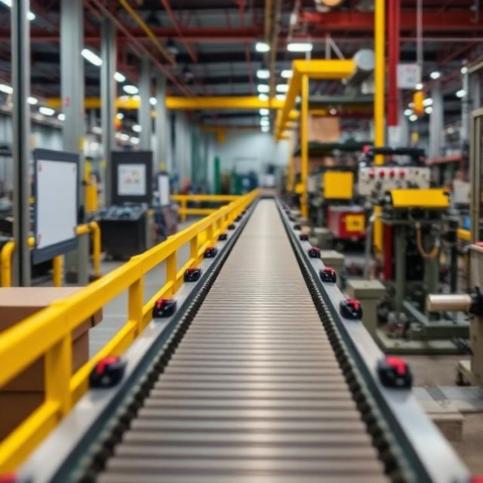
Detailed Applications Of Conveyor Systems Used In Manufacturing Operations
Key Takeaways
Conveyor systems are a staple across many industries, and manufacturing operations are no exception. What are the common applications of conveyors in manufacturing? How to choose the right conveyor for a specific operation? In this blog, Norpak Handling, a leading distributor of belt conveyors, roller conveyors, chain conveyors, and more, explores these questions in detail.
Why Are Conveyor Systems Essential In Modern Manufacturing?
The Role Of Conveyor Systems In Production Workflows
Conveyor systems are a bridge in modern manufacturing, as they connect different parts of production seamlessly. Understanding the basics of conveyor systems provides a strong foundation for selecting the right solution for manufacturing operations.
Improving Material Handling Efficiency
Material handling is an integral part of manufacturing. Conveyors help improve this process exponentially by removing manual intervention and increasing accuracy.
Supporting Continuous Manufacturing Operations
In cases where the manufacturing operations are continuous and around the clock, conveyors serve as a perfect support system as they are designed for such tasks.
Reducing Manual Handling And Workplace Risks
Lastly, conveyors reduce manual handling and all the workplace risks that are associated with it, bolstering safety.
Common Applications Of Conveyor Systems Across Manufacturing Industries
Assembly Line Operations
Many industries utilize assembly lines to bring multiple components together to create a single, cohesive product. This is then sent for further manufacturing or becomes the final consumer good. Conveyors are the bedrock of these assembly line operations as they bring different components together to a single facility.
Packaging And End-Of-Line Processing
Packaging is a key aspect of manufacturing. Finished products are required to be packaged for safe transportation. To handle the high throughput of products and to ensure their accurate packaging and dispatch, conveyor systems are used in these cases.
Material Transportation Between Workstations
Even before assembly, different parts of manufacturing are divided between different workstations. However, for minor assemblies, it is essential to bring these different products together. Conveyors perform this task well as they transport material effectively between different workstations, even before the final assembly line.
Sorting And Distribution
Material movement and transportation are not the only tasks that conveyors are good at. They are also used in sorting and distribution applications. If multiple types of products need to be segregated, then conveyors, particularly sortation conveyors, perform this specific task. Once sortation is done, the products are then distributed to the required areas in the facility or to other transportation equipment.
Quality Inspection Processes
Although not considered at the outset, quality inspection is also simplified in manufacturing facilities using conveyor systems. The conveyor can be used to send passable products to a different conveyor line and rejected ones to a different line, ensuring accurate quality inspection.
Storage And Warehouse Integration
Since warehouses and storage are major parts of manufacturing, conveyors also aid in these operations by moving products to and from storage facilities. In this way, conveyors help operate different parts of a manufacturing facility.
Conveyor Systems Used In Different Manufacturing Sectors
How are conveyor systems utilized across different industries? The subsequent section covers this question.
Automotive Manufacturing
The automotive manufacturing sector creates heavy parts for the engine block, chassis, and more. To effectively transport them for assembly, automotive manufacturers often rely on specialized automotive conveyor systems to improve production efficiency and material flow.
Food And Beverage Processing
In food and beverage processing, there is a requirement to adhere to strict hygiene standards. This means that conveyors must be able to handle regular exposure to water and cleaning chemicals. Stainless steel or plastic conveyor systems are often used in this case.
Pharmaceutical Manufacturing
Akin to food and beverage processing, pharmaceutical manufacturing requires pristine operating conditions, as contamination cannot be tolerated. The conveyors used in this sector are often highly sanitized required specialized conveyors that can withstand differing temperatures, chemicals, and cleaning agents.
Consumer Goods Production
Consumer goods are a versatile domain, ranging from small to heavy-duty goods. Conveyors used in this sector must be able to handle a wide range of products for effective transportation, sortation, quality checking, and more.
E-commerce And Distribution Facilities
With e-commerce facilities, there is an ever-increasing demand for producing and dispatching more goods. Any major wish fulfillment facility must be able to scale up its operations for this purpose. Conveyors used here also need to be portable and modular to meet the ever-changing demand of the sector. The same holds for distribution facilities as well.
Selecting the Right Conveyor System for Your Manufacturing Operation
Understanding Product Characteristics
What are the dimensions and weight of the product? Is it cartons, boxes, pallets, cases, or something more non-uniform? Similarly, is it a lightweight, medium-weight, or heavy product? Understanding these product characteristics is important to pinpoint the overall conveyor requirement. For instance, comparing different case conveyor systems helps manufacturers identify the most suitable case handling solution.
Evaluating Production Throughput
Production throughput is another major consideration when choosing a conveyor system for a specific application. The rate of product flow will require a conveyor that can handle such high volume, with the ability to handle even more products if required.
Considering Facility Layout
Aside from product dimensions and throughput, the layout of the facility also plays a major role. Spatial constraints are a major factor to consider as it precedes other characteristics. For instance, incline conveyors are suitable in cases where space is at a premium. Alternatively, one can even consider overhead conveyors if floor space is highly valuable.
Planning For Future Expansion
Conveyors must be able to expand along with operational demand. Modular conveyor systems are a great solution in this instance. If not entirely, a part of the conveyor system can be made modular for easier future expansion.
Balancing Cost And Operational Efficiency
At last comes the most important factor of all, cost. High cost at the expense of operational efficiency is not a suitable outcome for manufacturing facilities. This is why care must be taken to balance out the two for effective conveyor system selection, regardless of application.
Specialized Conveyor Solutions For Complex Manufacturing Environments
Overhead Conveyor Systems
When floor space is limited or required for other operations, overhead conveyor systems emerge as a perfect option. They ensure uninterrupted workflows and are suitable for handling light to medium loads.
Spiral Conveyor Systems
Another way to maximize vertical space is by means of spiral conveyor systems. As the name suggests, these are conveyors shaped in a spiral form, occupying a lot space than incline conveyors and changing gradients effectively. They help maintain a continuous product flow without compromising space.
Incline And Decline Conveyors
For moving products up and down an incline to ensure effective product transportation, incline and decline conveyors can be considered. In the case of non-powered conveyors, such as gravity conveyors, a steady decline can also help ensure easy and effective transportation of products.
Custom Conveyor Configurations
Lastly, for specialized cases with very particular requirements, custom conveyors can be considered. A proper system integrator can help figure out your requirements to create a material handling system that is suited for your specific needs.
Best Practices For Maximizing Conveyor Performance
Preventive Maintenance Planning
To prevent unexpected downtime, it is best to opt for preventive maintenance planning. This can include planned downtime to examine different parts of the conveyor to ensure optimal performance and to perform any minor repairs if needed.
Operator Training
Conveyors do not operate in a vacuum. Skilled technicians and operators are required to run them effectively. Therefore, proper operator training is a part of ensuring optimal conveyor performance.
Monitoring System Performance
Monitoring system performance is an integral part of improving conveyor performance. For instance, implementing strategies to improve conveyor energy efficiency can lower operating costs while maintaining productivity.
Optimizing Conveyor Layouts
Conveyor layouts also determine performance. This is why optimizing conveyor layout goes a long way towards improving conveyor performance in the long run.
Conclusion: Choosing Conveyor Systems That Support Long-Term Manufacturing Growth
To conclude, there is a major correlation between applications of conveyors in manufacturing and selecting the right conveyor for a specific use. With a clear idea of these concepts, it is easy to choose a conveyor that supports long-term manufacturing growth.
Norpak Handling is a leading system integrator and distributor of conveyor machines in Port Hope, Ontario. Our conveyor system range includes gravity conveyors, roller conveyors, incline conveyors, chain conveyors, belt conveyors, plastic conveyors, accumulation conveyors, and much more. Our experts are also adept at designing custom solutions that match unique design and engineering specifications. Contact us today to learn more.
FAQs
What industries use conveyor systems?
Automotive manufacturing, food and beverage production, pharmaceutical manufacturing, and e-commerce and distribution centers commonly use conveyor systems.
How do I choose the right conveyor system?
To choose the right conveyor system, consider application, space, cost, operational requirements, and product specifications.
What are the most common types of conveyor systems?
The most common types of conveyors include belt conveyors, roller conveyors, chain conveyors, and more.
How do conveyor systems improve manufacturing efficiency?
Conveyor systems improve manufacturing efficiency by automating material movement, maintaining a continuous production flow, and reducing the need for heavy manual lifting.