
Key Takeaways
- Curved conveyors are designed to carry goods around corners
- Curved conveyors are defined by their unique path
- Curved conveyor types include powered, belted, roller, 90-degree transfer, and more
- Suitable for warehousing, distribution, packaging, manufacturing, material handling, and more
- Importance of selecting the right curved conveyor, maintenance, and upkeep
- Choosing the right type of curved conveyor based on applications
What Is A Curved Conveyor Belt?
How Curved Conveyor Belts Differ From Straight Conveyors
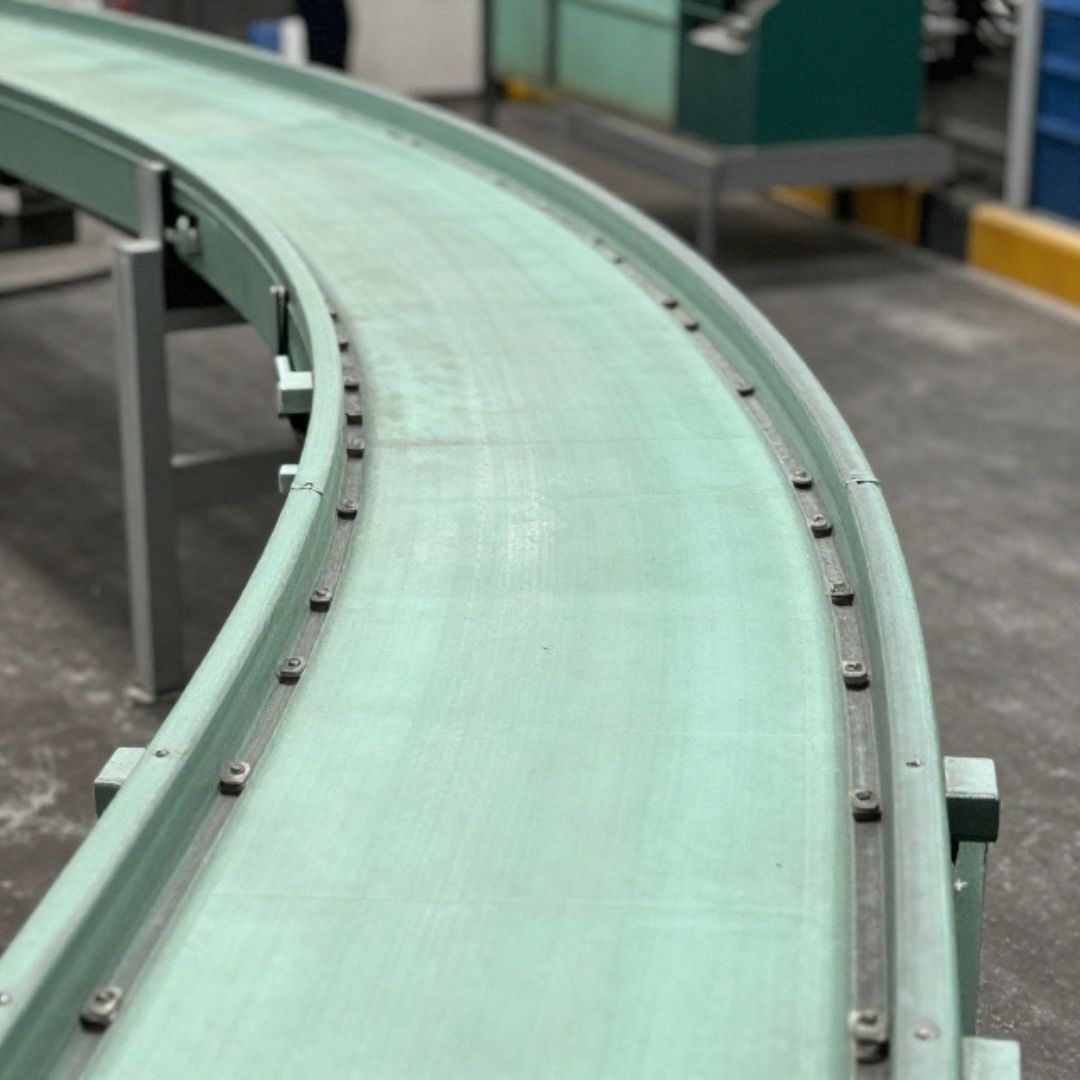
Curved belt conveyors mainly differ from straight conveyors in their profile. Instead of a straight profile, curved conveyors can be set at different angles, such as 45 degrees or more, ensuring efficient material handling of goods across tight spaces. It can help change the direction of motion of the unit loads without hindering the overall conveying process or drastically changing the orientation of the product.
Common Curve Angles And Configurations
Common curve angles and configurations of conveyors include 45, 90, and 180 degrees. However, the angles are not limited to these configurations. Depending on the application and the unique nature of operations, the conveyors can be designed to suit any angle that corresponds to the easy flow of products within a particular facility. For instance, curved belt conveyors can be configured at any angle, as long as the requirements of a belt conveyor remain valid. Much like their straight counterparts, curved belt conveyors offer excellent friction and traction, making them suitable for specific types of products.
How Curved Conveyor Belts Work
Belt Movement Through A Curved Path
A curved belt conveyor comprises two components: curved pulleys and parts of the belt that are spliced together. The parts of the belt are cut and spliced together to create the desired curves, and this loop is then set around curved or conical pulleys to facilitate the specialized movement.
Maintaining Product Position And Stability
While curved belt conveyors can handle objects of different dimensions, maintaining product position and stability is still important. This is done by making the inner and outer belt paths achieve a gentler angle than the internal paths. This enables a smoother and more controlled movement of the belt conveyor, ensuring that products do not slip or fall off the conveyor during tight corners. This is invaluable to maintain the proper orientation of the product during transportation.
The Role Of Belt Radius And Conveyor Geometry
The belt radius is vital for conveyor geometry, as it impacts other factors such as conveyor speed and material handling. The tighter the radius, for example, the bigger the change in speed will be between the inner and outer edges of the belt. This can significantly impact product stability and alignment. Hence, if speed needs to be faster, then the conveyor belt radius should be larger, if space allows. It will also impact load considerations, as heavier loads will have greater momentum at faster speeds.
Types Of Curved Conveyor Systems
| Conveyor Type | Best Suited For | Key Considerations |
Powered Belt Curves | Ideal for smooth and continuous movement of delicate and non-rolling goods, as well as offering accurate product positioning through turns
| The biggest considerations for powered belt curve conveyors include the inner and outer radii of the belt and the conical pulley design |
Transnorm Belt Curves | The transnorm belt curve conveyor is best-suited for maintaining a positive flow of goods at an angle. The design allows the conveyor to transport a versatile range of products | The key considerations for this type of curved belt conveyor include belt tracking, friction, noise, degree of curve, drive tension, and load handling |
Roller-Based Curves | Roller-based curved conveyors have rollers that are tapered and set at an angle for smooth product flow. They are best-suited for products with smooth characteristics, such as boxes or bins
| The tapered roller design, the curve angle, the inner and outer radii of the conveyor, the conveyor width, roller pitch, load capacity, and drive mechanism are all vital considerations for roller-based curved conveyors |
90-Degree Transfers | As the name suggests, 90-degree transfers are best-suited for transporting goods across a sharp, 90-degree angle. They are also excellent for accurate product positioning and orientation | The key considerations for 90–degree transfers include pop-up transfers, accessories such as pushers and diverters, product geometry, compatibility, and spatial constraints |
Where Curved Conveyor Belts Are Used
Warehousing And Distribution:
- In warehousing and distribution, they serve to move packages around tight corners
- As far as curved conveyor applications are concerned, they are invaluable for sortation systems.
Manufacturing And Material Handling:
- Moving products through an assembly line in manufacturing and material handling operations
- Important for navigating products across regions with space constraints.
Packaging And Product Routing:
- In the case of packaging and product routing, curved conveyor systems are used to maintain a continuous product flow without taking up a lot of floor space
- They are also key in transporting goods between machinery and workstations without the need for specialized manual transfer arrangements
- Lastly, they also help connect different sections of a production line in complex material handling facilities.
Applications Requiring Space-Efficient Layouts:
- Aside from these specific applications, curved conveyor belts are critical in any operations where space efficiency is paramount. For example, they can be considered in applications where straight conveyors are taking up too much space or obstructing other machinery.
- Even with curved conveyors, a choice can be made to save more space in the form of 90-degree transfers instead of curves if required.
How To Choose The Right Curved Conveyor Belt
1. Determine The Required Curve Angle
The first criterion to consider is the required curve angle of the conveyor belt. This will totally depend on the application and available spatial constraints. Typically, it is best to choose conveyor options that match the profile of the straight conveyor. For example, where a straight belt conveyor was used, a curved belt conveyor can do better.
2. Evaluate Product Size, Shape, And Stability
The next step involves evaluating product size, shape, and stability. The size of the product will determine the width and overall radius of the conveyors. The shape will determine the type of conveyor to be considered. For instance, more fragile goods are better-suited for curved belt conveyors, and more rounded objects are ideal for curved roller conveyors.
3. Calculate Required Belt Width And Radius
Based on the curve angle and product characteristics, it is now possible to calculate the required belt width and radius for a specific operation. Make sure to consider inner and outer radii separately, but the difference between the two should not be significant, as it will greatly impact product speed.
4. Consider Load Capacity And Conveyor Speed
When moving along a curve, the weight of a product becomes paramount. Based on conveyor speed, it can have significant momentum. Therefore, load capacity and conveyor speed considerations go hand-in-hand. This will also determine how well the product is handled during peak throughput.
5. Check Available Floor Space And Layout
Much like straight conveyors, the available floor space and layout will significantly impact all other aspects of curved conveyor system selection. For instance, tighter spaces will require curves with smaller radii or sharper turns.
6. Evaluate Integration With Existing Conveyors
No facility operates conveyors in a vacuum. The curved conveyor must be able to integrate with existing conveyor systems to enhance operations. The best-designed belt conveyor will be in vain if the integration with existing conveyor systems becomes a challenge.
7. Consider Maintenance And Long-Term Operation
Lastly, do not forget the maintenance and long-term operation costs of the conveyor. Curved conveyors can have a higher maintenance cost and a tighter schedule due to their unique profile. Therefore, for smooth long-term operations, it is necessary to have scheduled maintenance protocols for curved belt conveyors.
Curved Conveyor Belt Vs. Other Conveyor Options
Curved Belt Conveyor Vs. Straight Conveyor
If a facility requires product movement with spatial constraints and a limited footprint, curved belt conveyors are a better choice than straight conveyors. This is because curved belt conveyors offer smooth product movement at an angle, saving space and ensuring smooth movement.
Curved Belt Conveyor Vs. Live Roller Curve
Between the belt curve and live roller conveyor, the choice is mainly dependent on the product characteristics. If the product being transported is more fragile, then curved belt conveyors are a good choice due to their ability to offer proper belt traction. Conversely, for products that are robust and unusually shaped, such as bins or boxes, live roller curve conveyors are better, as product integrity will not be compromised.
When A 90-Degree Transfer May Be Better
In facilities with very limited space where even a 90-degree curved conveyor might occupy too much space, a 90-degree transfer may be a better fit. It is also an excellent choice for accurate product tracking and orientation without the need for adding expensive sensors.
Installation, Integration, And Maintenance Considerations
Integrating Curves With Existing Conveyor Lines
As mentioned in the conveyor selection section, integrating the curved conveyor with existing conveyor lines is vital for operations, as easy integration at the outset is always better than future changes. Moreover, when considered during selection, it makes the purchase of curved conveyors easier and more precise.
Maintaining Belt Tracking And Product Flow
- Belt tracking
- Product alignment
- Product flow
- Conveyor connections
Routine Inspection And Maintenance
- Belt condition
- Drive components
- Bearings and moving components
- Guarding and safety
- Unusual noise or vibration
- Routine cleaning and inspection
Curved Conveyor Belt Selection Checklist
- Required curve angle identified
- Product dimensions and characteristics evaluated
- Required belt width determined
- Conveyor belt radius confirmed
- Load capacity established
- Required speed and throughput established
- Available floor space measured
- Existing conveyor connections evaluated
- Maintenance requirements considered
- Safety and operational requirements reviewed
Conclusion
To conclude, curved belt conveyors are key for efficient material handling, particularly in facilities with spatial constraints. The type and selection of curved conveyor will depend on several factors such as product considerations, belt radius, belt width, spatial constraints, integration, and more.
For more information on conveyor systems and their utility, contact us at Norpak Handling today. As a major distributor and system integrator of conveyors in Port Hope, Ontario, we offer a wide variety of products such as belt conveyors, roller conveyors, chain conveyors, and more. Click here to get in touch with our experts.
Frequently Asked Questions
What is a curved conveyor belt used for?
Curved conveyor belts are mainly used for guiding products along a curve without altering their orientation to a significant degree.
What is the minimum radius of a curved conveyor belt?
Generally, the minimum radius of a curved conveyor is twice the width of the conveyor belt.
What is a 90-degree belt conveyor?
A 90-degree belt conveyor is a specialized form of conveyor system that moves products along a sharp, 90-degree angle or curve.
How do you choose a curved conveyor?
To choose the right curved conveyor, consider curve angle, product shape, size and weight, conveyor radius, speed, floor space, integration with current systems, maintenance, and long-term utility.
Are curved belt conveyors better than roller conveyors?
No, neither curved belt conveyors nor roller conveyors is better than the other. Their compatibility depends on specific applications and product characteristics.