Key Takeaways
- Conveyor transfers work by moving products along different conveyor lines.
- Types of conveyor transfer systems include roller conveyor transfers, belt and nose-bar transfers, conveyor transfer plates, dead plates, O-ring transfers, and 90-degree conveyor transfers.
- Applications of conveyor transfers include product routing, sorting, and diverting.
- Selection of conveyor transfers includes consideration of product size, weight, shape, product stability, alignment, conveyor speed, transfer direction, floor space, and equipment compatibility.
What Are Conveyor Transfers And How Do They Work?
How Conveyor Transfers Connect Material Handling Processes
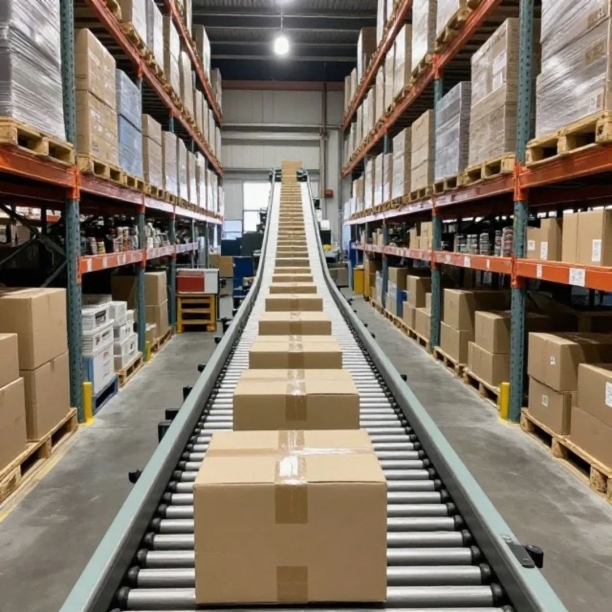
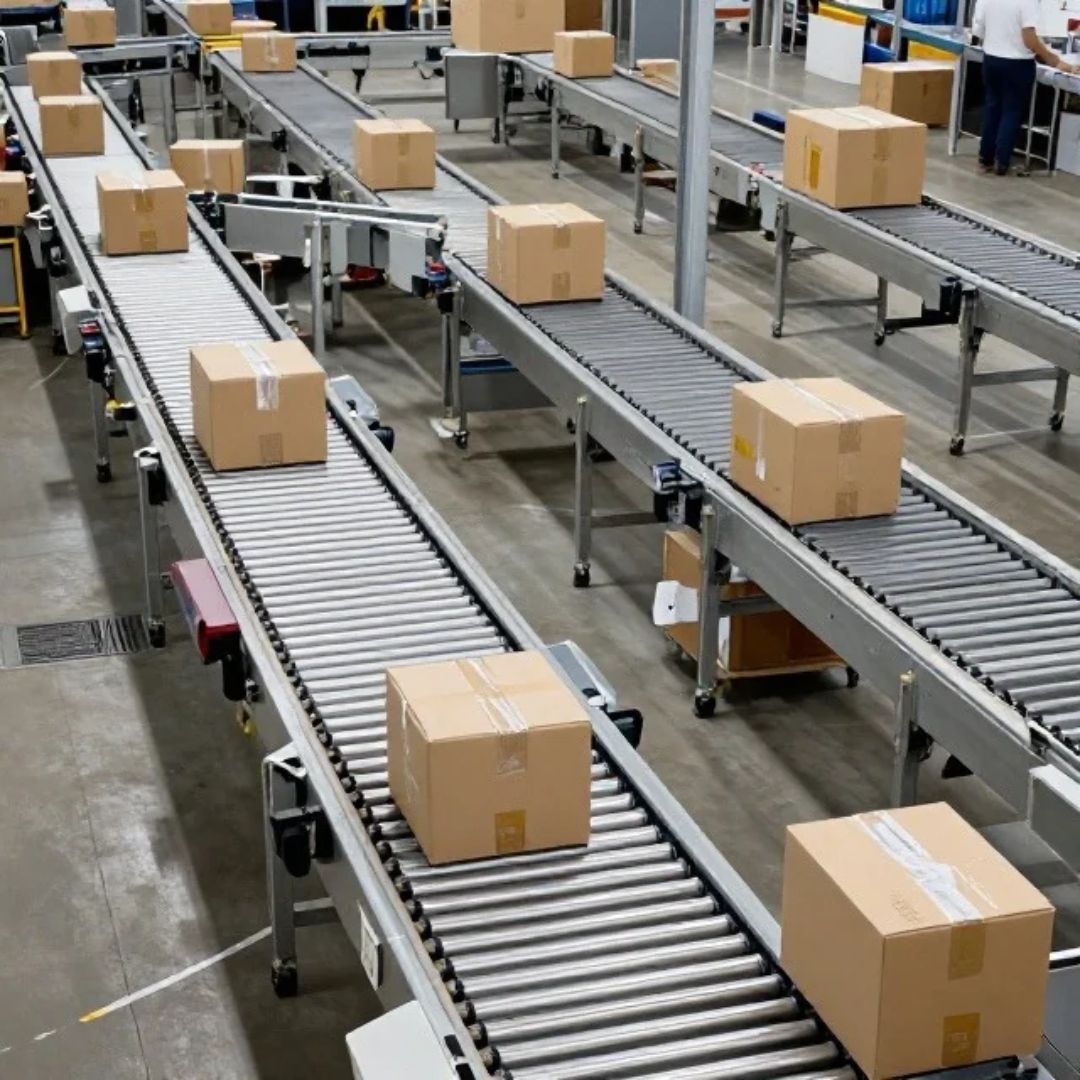
Conveyor transfer connects material handling processes by transferring goods from one conveyor line to another. They serve as a critical junction in material handling operations, and ineffective transfers or missing systems can create major bottlenecks in complex processes.
Inline, Parallel, And 90-Degree Conveyor Transfers
Common types of conveyor transfers include inline, parallel, and 90-degree transfers. In-line transfer has both the discharging and receiving belts operating in the same direction. In parallel belt transfers, the products are moved across parallel conveyor lines. As for 90-degree conveyor transfers, when the products have to move through a perpendicular angle, these types of conveyor systems are ideal.
Types Of Conveyor Transfer Systems And Their Applications
| Conveyor Transfer Type | Transfer Mechanism | Suitable Products | Directional Capabilities | Key Limitations |
|---|---|---|---|---|
| Roller Conveyor Transfers | Can be gravity-based or powered to move products from one line to another | Relatively heavy and robust products | Usually uni-directional | Power requirements, synchronization, and maintenance |
| Belt And Nose-Bar Transfers | Uses a small conveyor belt as a transfer point between two belts. It also uses a small roller to minimize the gap between two conveyors | Ideal for handling small, light, or uneven-shaped parts | Can be linear, perpendicular, and parallel directional capabilities | Belt versatility, high conveyor speeds and conveyor layout |
| Conveyor Transfer Plates And Dead Plates | Transfer plates guide products from one conveyor to another | Large-scale bulk products and small products | Unidirectional | Low-capacity production lines, additional guiding |
| O-Ring Conveyor Transfers | Moves products at right angles between parallel or adjacent conveyors
| Flat-bottomed units such as boxes, cartons, and totes | Right-angle transfers. Can be reversible
| Compatibility, load capacity, transfer speeds
|
| ARB 90-Degree Conveyor Transfers | 90-degree conveyor transfer with accuracy and excellent product handling
| Fragile products that might be damaged with conventional 90-degree transfers
| Right-angle directional movement
| Product dimensions, shapes, and weight restrictions
|
| Pop-Up And Right-Angle Transfer Mechanisms | A recessed system which pops up during transfer at a right angle
| Carts, totes and pallets
| Right-angle directional movement
| Product compatibility, alignment, throughput
|
Roller Conveyor Transfers
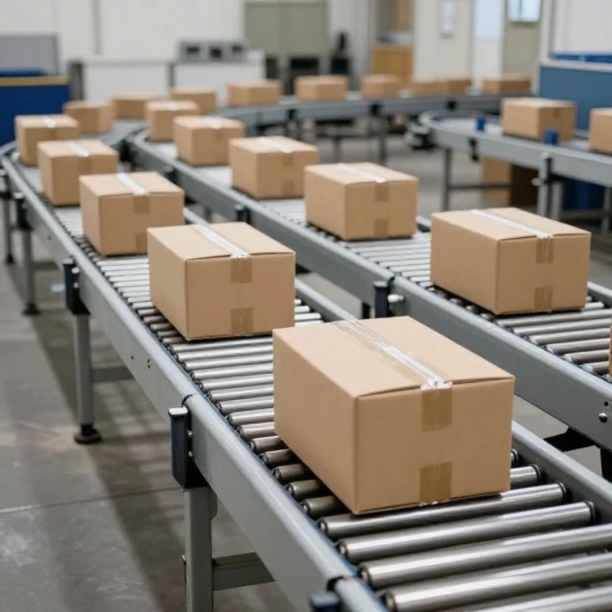
Roller conveyor transfers are gravity or powered iterations that can move heavy and robust goods from one line to another.
Belt And Nose-Bar Transfers
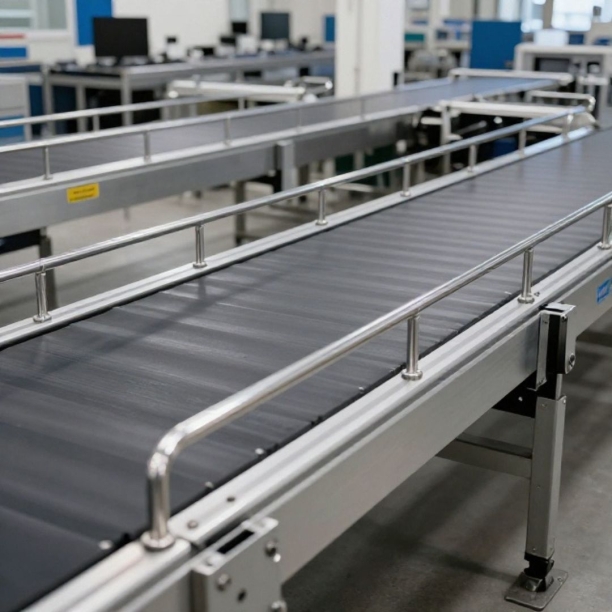
A belt and a small roller connect two different conveyor belts to reduce the gap between the conveyors and to facilitate easy movement of goods.
Conveyor Transfer Plates And Dead Plates
Use passive plates to transport goods in bulk between two conveyor systems. Highly efficient and cost-effective in busy facilities.
O-Ring Conveyor Transfers
O-ring conveyor transfers excel at moving flat-bottomed products at right angles between two parallel or inline conveyors.
ARB 90-Degree Conveyor Transfers
These ARB 90-degree transfers also enable perpendicular transfer, but with a high degree of accuracy and handling.
Pop-Up And Right-Angle Transfer Mechanisms
In these transfer systems, the products are moved at a right angle by a pop-up plate or mechanism that is activated during transfer.
Where Are Conveyor Transfers Used In Industrial Operations?
Product Routing Between Conveyor Lines
- When products have to be routed or moved across one or more conveyor lines, conveyor transfers are used.
- It can include inline transfers, side-to-side transfers, 90-degree transfers, and more.
Sorting And Diverting Packages In Distribution Centres
- In distribution centres, there are numerous purposes other than moving products.
- This includes sorting and diverting, which requires conveyor transfers for accurate scanning and segregation to relevant conveyor lines.
Changing Product Direction In Space-Constrained Layouts
- In operations where spatial constraints are a major concern, conveyor transfers are vital.
- The use of 90-degree conveyor transfers is invaluable here, as they ensure efficient transfer without taking up a lot of space.
Key Factors To Consider When Selecting Conveyor Transfers
Product Size, Weight, Shape, And Bottom Surface
The product is a major consideration when selecting conveyor transfers, much like choosing the conveyors themselves. This includes key criteria such as product size, weight, and shape. The dimensions of the product will, of course, determine the size and selection of the transfer, whereas the weight will also rule out certain options. Similarly, for products with flat bottoms, certain types of transfers are better than others.
Transfer Gaps, Product Stability, And Conveyor Alignment
Another key consideration is the transfer gap between the two conveyors, product stability, and conveyor alignment. For instance, if it is important to reduce the gap between conveyors, then a belt and nose-bar transfer might be better. Similarly, for better product stability during transfer, specialized 90-degree conveyor transfers might be the better choice.
Transfer Direction And Available Floor Space
Does the product require transfer along only one direction or multiple directions? This important conveyor specification will also impact the selection of the conveyor transfer. In a similar vein, available floor space also has a major impact. For instance, a 90-degree transfer offers movement in a different direction and saves on available floor space.
Conveyor Speed, Throughput, And Product Orientation
The speed of the conveyor, overall throughput, and product orientation have a major impact on the selection of conveyor transfer. For instance, conveyor speed is a bad fit for belt and nose bar transfers.
Compatibility With Existing Conveyor Equipment
Lastly, conveyor integration compatibility must not be forgotten. For example, conveyor transfer plates are the right choice for bulk conveyor systems with medium to low throughput.
90-Degree Conveyor Transfers: When Should You Use Them?
How 90-Degree Transfers Change Product Direction
90-degree conveyor transfers work primarily by means of pop-up rollers, which lift the products and transfer them at a perpendicular angle from one conveyor to another. It is best for accurate product transfer for carts, totes, and pallets.
ARB Transfers Vs. O-Ring Transfers
While the basic premise of ARB transfers and O-ring transfers is similar, the two vary in subtle ways. For one, ARB 90-degree transfers are more accurate and ideal for handling products with care. O-ring transfer, on the other hand, is more suitable for generic totes, bags, and boxes.
Right-Angle Transfers Vs. Curved Conveyors
When it comes to right-angle transfers versus conveyor curve selection, the main factor to consider is the layout. Curved conveyors are acceptable when there are no spatial constraints. But for operations with a compact conveyor layout, curved conveyors are not feasible. This is where right-angle transfers become invaluable.
How To Choose The Right Conveyor Transfer Method
Step 1 — Identify Product Handling Requirements
What are the product handling requirements? Is the product bulky, heavy, or flat-bottomed? This will determine the conveyor transfer method.
Step 2 — Determine Transfer Direction And Layout
The transfer direction and layout are closely connected. The smaller the layout, the more unique the direction of transfer, such as the 90-degree transfer being an ideal choice for compact layouts.
Step 3 — Match Transfer Technology To Product Characteristics
The conveyor transfer method technology selected for a specific operation must also be compatible with product characteristics. For instance, fragile products can be used only with specialized 90-degree transfers that are suitable for this purpose.
Step 4 — Verify Speed, Load Capacity, And System Compatibility
After selecting the conveyor transfer based on the above-mentioned criteria, verify the conveyor speed, load capacity, and system compatibility.
Step 5 — Validate Performance Before Installation
After verifying speed, load capacity, system compatibility, and other selection criteria, validate the performance of the conveyor transfer. Only after validating performance is the conveyor system suitable for installation.
Conveyor Transfer Selection Checklist
- Product dimensions
- Load capacity
- Transfer gaps
- Alignment
- Throughput
- Equipment integration
Product And Load Requirements
Make sure that the product and load requirements are compatible with the conveyor transfer being considered.
Transfer Mechanism And Conveyor Compatibility
Make sure that the transfer mechanism being selected is actually compatible with the type of conveyor it is being attached to.
Installation, Maintenance, And Safety Requirements
Make sure that the conveyor transfer adheres to all the installation, maintenance, and safety requirements.
Common Conveyor Transfer Problems And How to Avoid Them
Product Jams, Tipping, And Transfer Gaps
Choosing a conveyor transfer method that is incompatible with the products or applications can lead to product jams, cause bottlenecks, lead to tipping of the products, or cause transfer gaps if not planned properly.
Misalignment And Inconsistent Product Flow
Misalignment and inconsistent product flow can also be major issues created by conveyor transfer.
Incorrect Transfer Speed Or Load Capacity
Not choosing the right transfer speed or load capacity can lead to poor transfer outcomes such as breakdown, product tipping, or bottlenecks.
Frequently Asked Questions
What Is the Difference Between Inline And 90-Degree Conveyor Transfers?
An inline conveyor transfers products between two conveyors that are in close proximity to each other. 90-degree conveyor transfers, on the other hand, move products between two conveyors at a right angle.
Which Conveyor Transfer Method Is Best For Small Products?
Belt and nose-bar transfers are the ideal solution for small products.
How Do Conveyor Transfer Plates Work?
Transfer plates are installed at the end of the transfer system as an extension, acting as a cost-effective method to move products.
Can Roller Conveyor Transfers Handle Different Product Sizes?
Yes, roller conveyor transfers can handle relatively different product sizes and weights.
What Factors Determine The Right Conveyor Transfer System?
Factors that determine the right conveyor transfer system selection include product characteristics, transfer gaps, product stability, conveyor alignment, available floor space, transfer direction, conveyor speed, throughput, and compatibility.