Key Takeaways
When it comes to conveyor systems, the basic types include belt conveyors, roller conveyors, and chain conveyors. How do the three differ from one another in terms of features, applications, and selection criteria? Norpak Handling, a leading distributor of conveyors in Port Hope, Ontario, explores these questions and much more in this blog.
Understanding The Three Primary Conveyor Types
What Is A Belt Conveyor?
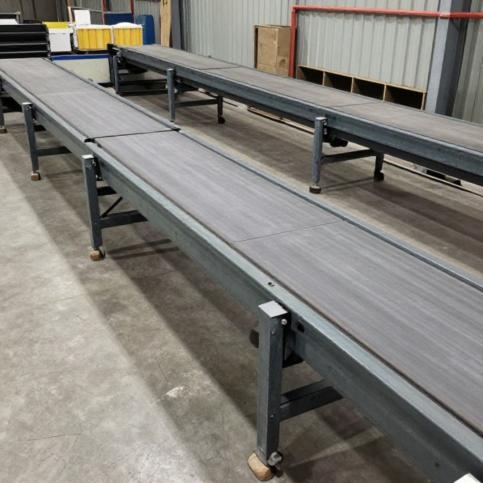
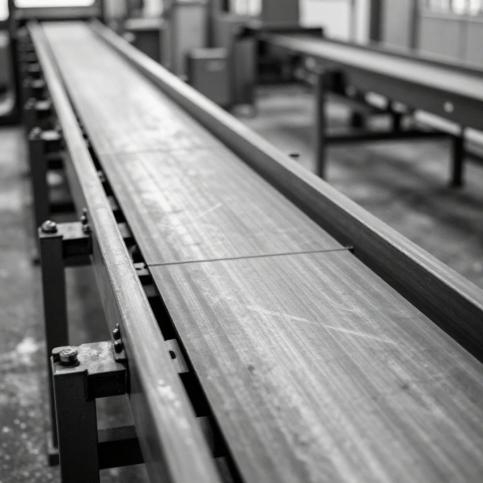
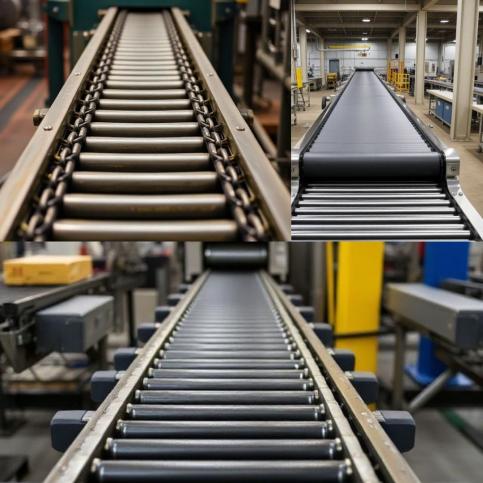
A belt conveyor is a material handling system featuring a belt made of any material, such as rubber or plastic, that is looped around pulleys. They are ideal for high-friction applications.
What Is A Roller Conveyor?
A roller conveyor comprises a series of rollers spaced equidistantly apart from each other that help with the movement of products.
What Is A Chain Conveyor?
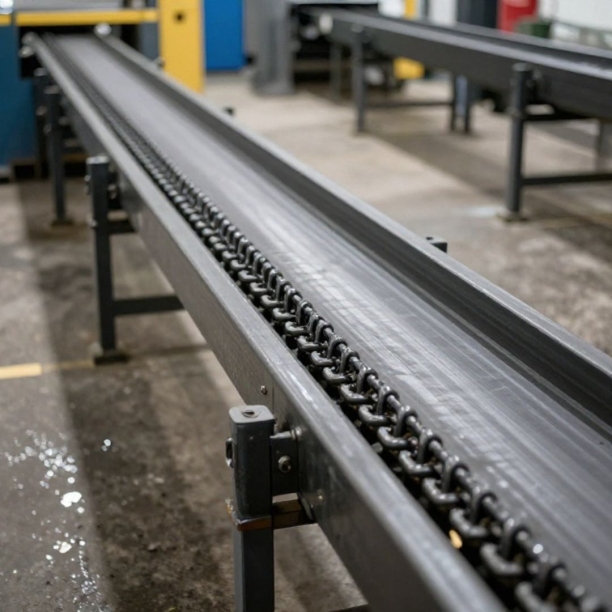
A chain conveyor uses a single strand or multiple strands of chains that are used to carry heavy products.
Why Does Conveyor Selection Matter?
Conveyor selection matters as it depends on the type of material being conveyed, its weight, dimensions, and operating conditions.
Comparing Belt, Roller, And Chain Conveyors
Working Principles
Each type of conveyor works on different working principles. In the case of a belt conveyor, an electric motor is used to drive a pulley, which, in turn, moves the belt in a continuous loop. Roller conveyors use the rollers to move objects in the direction of rotation of the parallel rollers. The rollers can be gravity-driven or powered. Lastly, chain conveyors use an electric motor to drive a sprocket that is connected to the chain. The chain moves objects along a fixed track.
Load Handling Capabilities
Out of the three, belt conveyors are the least adept at handling heavy loads. They are ideal for objects that are light to medium duty. Roller conveyors are more versatile as they can handle light as well as heavy objects. The load handling capacity here depends on the material and roller diameter. Chain conveyors are best suited for handling very heavy loads such as drums or pallets.
Material Compatibility
Belt conveyors are compatible with a wide range of materials as it offers more surface friction. However, roller conveyors are only suitable for flat surface products. Chain conveyors are similar in versatility to belt conveyors. However, they are only used in cases where belt conveyors cannot be employed.
Speed And Throughput
When it comes to speed and throughput, belt conveyors have the highest speed and throughput. Roller conveyors are considered average in this case, although they can have excellent throughput for heavy products too. Chain conveyors are more suited for slowly moving heavy products. As a result, their throughput is not very high.
Maintenance Requirements
In terms of maintenance, roller conveyors are the best due to fewer moving parts. Chain conveyors are the hardest, while roller conveyors fall in the middle.
Cost Considerations
Chain conveyors are the most expensive due to specialized design and applications. Roller conveyors are the least expensive due to their simple design, and belt conveyors fall in the middle.
Typical Applications Of Each Conveyor Type
Belt Conveyors For Packaged Goods
Belt conveyors are the most versatile in terms of handling a wide range of materials. Be it curved objects or packaged goods, belt conveyors are the ideal choice in these circumstances. They are also an excellent choice in terms of maintaining constant conveyor speeds. For more details, learning about different conveyor belt types is important as it helps determine which solution best suits warehouse and distribution applications.
Roller Conveyors For Cartons And Pallets
Cartons and pallets are excellent for roller conveyors due to their fixed bottom surface. Due to their curvature, roller conveyors cannot handle curved products. Cartons and pallets have flat bottoms, making them easy to transport. Moreover, rollers are also heavy enough to handle them without affecting throughput.
Chain Conveyors For Heavy-Duty Materials
Chain conveyors are designed for moving heavy products or for moving materials in harsh environmental conditions. For products that even heavy-duty roller conveyors cannot handle, it is best to choose chain conveyors.
Industry-Specific Applications
Apart from weight-based classification, conveyors can also be selected on the basis of industry-specific applications. For instance, chain conveyors are used in food processing, coal mining, sewage treatment, and other specialized applications; roller conveyors can be used for load accumulation and load transfer, pallet dispensing, and more; and belt conveyors best serve assembly lines and high-speed transportation.
Indoor And Outdoor Operations
Operating environments also determine conveyor selection. Chain conveyors, for example, can be used in outdoor settings as they can handle temperature fluctuations and environmental contaminants better than other conveyor systems.
Key Factors To Consider When Selecting A Conveyor System
Product Characteristics
What are the dimensions and weight characteristics of the product being conveyed? Is it heavy and irregular in shape? Then, chain conveyors might be a better fit. Is it a pallet or drum? Conveyor rollers of roller conveyors are right for handling them. Do packaged goods need to be transported at high speeds? Then perhaps belt conveyors are the best-suited.
Required Production Capacity
Production capacity or throughput is another important consideration. For high throughput, nothing beats belt conveyors. For those seeking a balance between throughput and handling heavy loads, roller conveyors are the best. If throughput is not a top priority, chain conveyors can be considered.
Facility Layout And Available Space
The layout of the facility also plays a major role. Floor space will determine the conveyor length and its efficacy. Although there is no specific difference between the three in terms of spatial constraints, incline versions can be considered to save more space in the long term.
Environmental Conditions
Are the products passing through a freezer, oven, or clean rooms? This will majorly determine the type of conveyor to be used. Only a chain conveyor is robust enough to handle major temperature fluctuations and regular cleaning.
Maintenance And Lifecycle Costs
Along with the utility of the conveyor, it is important to consider its maintenance and lifecycle costs. These factors have to align with the application and efficiency to be considered a viable choice.
Future Scalability
Lastly, make sure that the conveyor is scalable for future expansion, as material handling should always consider the future.
When Alternative Conveyor Systems Are a Better Fit
When To Consider Overhead Conveyors
In the case of limited floor space, it is optimal to go for overhead conveyors, as it ensures efficient overhead material transport without taking up a lot of space.
Applications Suited For Spiral Conveyors
For vertical product movement, spiral conveyors provide a compact alternative to traditional incline systems. They are suitable for cases where there is not enough space for incline conveyors.
Combining Multiple Conveyor Systems
In some facilities, a single type of conveyor may not be a great choice, as different types of materials are to be transported at different rates. In such cases, multiple conveyor systems can be considered on the basis of materials and specific applications.
Optimizing Facility Workflow
Lastly, when it comes to optimizing the workflow of a specific facility, alternative conveyor systems can be considered, such as sorter conveyors.
Choosing The Right Chain Conveyor Configuration
Single-Strand Chain Conveyors
Single-strand chain conveyors are more suited for lightweight applications and for narrow products.
Multi-Strand Chain Conveyors
Multi-strand chain conveyors use multiple chain strands that are looped over and function in parallel with each other. They are best suited for heavy-duty applications with wide product profiles.
Drag Chain Conveyors
Drag chain conveyors are best suited for protecting fragile products and transporting heavy goods, for optimal spill control, or for tough environments.
Slat Chain Conveyors
When you need a rigid, durable moving platform to transport heavy, hot, or irregularly shaped products stably along a production line, slat chain conveyors are the ideal choice.
Overall, different chain conveyor types are designed to accommodate varying load capacities and industrial applications.
Conclusion
In closing, conveyors can vary from belt and roller conveyors to chain conveyors. Their features, applications, and selection differ significantly from one another.
Want to know which type of conveyor is right for your application? Contact us at Norpak Handling today. Our massive inventory of general conveyor systems includes conveyor rollers, belt conveyors, chain conveyors, and more. Specializing in customized material handling solutions, you can get in touch with us today to learn more about how we can boost your business operations with our innovative equipment and skills.
FAQs
What is the difference between belt, roller, and chain conveyors?
The difference between belt, roller, and chain conveyors depends on the type of conveying material. One uses a conveyor belt, one uses conveyor rollers, and one uses looped chains.
Which conveyor is best for heavy-duty applications?
Chain conveyors are the best for heavy-duty applications.
How do I choose the right conveyor system?
To choose the right conveyor system, consider cost, application, spatial constraints, product dimensions, product load, and more.